
Monday, January 18, 2010


Saturday, January 16, 2010
By Means of a Cunning Semantic Subterfuge
Portraits From Memory (Bertrand Russell) a wonderful piece by Beyond The Fringe.
'Bertrand Russell: One of the advantages of living in Great Court, Trinity, I seem to recall, was the fact that one could pop across at any time of the day or night and trap the then young G.E. Moore into a logical falsehood by means of a cunning semantic subterfuge. I recall one occasion with particular vividness. I had popped across and had knocked upon his door. "Come in", he said. I decided to wait awhile in order to test the validity of his proposition. "Come in", he said once again. "Very well", I replied, "if that is in fact truly what you wish".
I opened the door accordingly and went in, and there was Moore seated by the fire with a basket upon his knees. "Moore", I said, "do you have any apples in that basket?" "No", he replied, and smiled seraphically, as was his wont. I decided to try a different logical tack. "Moore", I said, "do you then have some apples in that basket?" "No", he replied, leaving me in a logical cleft stick from which I had but one way out. "Moore", I said, "do you then have apples in that basket?" "Yes", he replied. And from that day forth, we remained the very closest of friends.'
From Jonathan Miller [St John's], 'Portrait from Memory', on the LP Beyond the Fringe (1962)
Monday, January 11, 2010
Personhood

Cat and Girl answers a question about personhood that should clear up quite a few philosophical debates. (click on thumbnail to see comic)
Pragmaticism
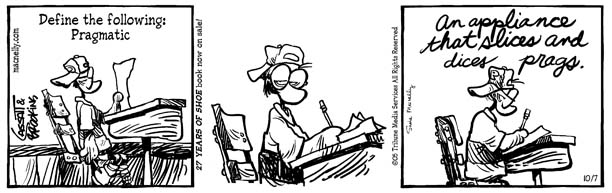 William James hated the common use of his term "Pragmatism" so much that he coined the mouthful of a word "Pragmaticism" to describe his view in the hopes that it would not catch on. It hasn't. Shoe, gives us its own definition of "Pragmatic" in this October 7th 2005 strip (click on thumbnail to enlarge) as an "appliance that slices and dices prags".
James objection to the simplification of the term in common usage, and this comics implicature that even that common usage is to complex for the children of today seemed to me mildly funny... however, unfortunately, I have discovered in the writing of this post that "Prag" has a somewhat unsavoury slang meaning; which darkens what I intended to be a light hearted post teasing James about his objection to the common use of "Pragmatism".
Perhaps James' objection to the popular use of his term was much more farsighted than I thought.
Enquivering
In 2000 they published a translation of Heidegger's Contributions to Philosophy (From Enowning) and Simon Blackburn wrote a review in The New Republic entitled "Enquivering" which will go down as a classic summing up of the problems of a certain sort of continental philosophy especially prevalent in Heidegger scholarship. The review begins with an honest assessment of the polarized opinion professional philosophers have about Heidegger:
Blackburn notes that however, "Neither view allows much compromise. But it was not always so." He notes that phenomenology was taken seriously by early Anglo-American philosophers and that for example Ryle wrote a "wrote a long, penetrating, and moderately admiring review" of Being and Time however, "Ryle noted an alarming tendency toward unintelligibility even in Heidegger's early work, and this is the tendency that blossomed." Heidegger, Blackburn notes:
This is Blackburn's main thesis that Heidegger is selling a "primal story" which tells of "a primordial golden age, when man was united with himself, with his fellow man, and with nature" and as with all golden ages there must be "a fall, when primitive innocence and unity were destroyed and replaced by something worse" Heidegger's twist to this primal story was that "he grafted onto phenomenology a secular version (or at least a non-Christian and philosophical version) of the primal story". Such a story Blackburn argues is attractive because of our human tendency to "mourn what might have been". To do this the story must not be intelligible as Heidegger tells us, "Making itself intelligible is suicide for philosophy."
So Blackburn notes:
If you are a believer, then Martin Heidegger was an unparalleled modern thinker, whose profound diagnosis of the condition of mankind in the twentieth century rightly dominated large tracts of culture, and directed the finest subsequent work in the humanities. If you are not, then he is a dismal windbag, whose influence has been completely disastrous, and whose affinity with the Nazis merely indicates the vacuum where, in most other philosophers, there would have been a combination of common sense and common decency.
Blackburn notes that however, "Neither view allows much compromise. But it was not always so." He notes that phenomenology was taken seriously by early Anglo-American philosophers and that for example Ryle wrote a "wrote a long, penetrating, and moderately admiring review" of Being and Time however, "Ryle noted an alarming tendency toward unintelligibility even in Heidegger's early work, and this is the tendency that blossomed." Heidegger, Blackburn notes:
...drifted away from the connection with phenomenology, just as he repudiated Husserl, in order to develop himself neither as a philosopher nor as a poet, but as an oracle.
This is Blackburn's main thesis that Heidegger is selling a "primal story" which tells of "a primordial golden age, when man was united with himself, with his fellow man, and with nature" and as with all golden ages there must be "a fall, when primitive innocence and unity were destroyed and replaced by something worse" Heidegger's twist to this primal story was that "he grafted onto phenomenology a secular version (or at least a non-Christian and philosophical version) of the primal story". Such a story Blackburn argues is attractive because of our human tendency to "mourn what might have been". To do this the story must not be intelligible as Heidegger tells us, "Making itself intelligible is suicide for philosophy."
So Blackburn notes:
Contributions to philosophy (From Enowning) is a translation, into something very remote from English, of philosophical notebooks that Heidegger wrote in the 1920s, in something fairly remote from German.Thus Blackburn tells us that the incomprehensibility of Heidegger's latter writings means:
He can be an icon for the Nazi, the priest, the environmentalist, or the hippie. He may be a defender of the faith, a poet-philosopher for the Society of Jesus, or the naysayer whose rejection of modern mechanical life is a timely, authentic update of that of Carlyle or Ruskin. He can be a pragmatist, or the enemy of dreary technology. All you have to do is accept the prospectus, and inscribe your own fantasy.You must not mind drowning (think of it as the oceanic feeling), and you may need to leave behind any tinge of common sense, science, logic, history, or reason--but these are easy burdens to shed in difficult times. In any event, like any good salvationist, the master has already instructed you to do it, by precept and by example.The full review is available here.
Subscribe to:
Posts (Atom)

 Posts
Posts


